BCM 325 Beta Comment’s

After the submission of the BCM325 digital artefact beta we were tasked to evaluate our peer’s beta video and blog submissions. The task is aimed to share our personal thoughts and ideas on our classmate’s work, as well as giving the opportunity to reflect on our own project progression, gaining ideas and methods to finish up our digital artefacts ready for submission.

The three classmates I provided feedback to were:

  • Karli Connors
  • Tamara Goldsmith
  • Madeleine Jones

Karli Connors

Description: Karli has created a blog site called ‘Vitality Through Veganism’ which aims to explore the future of the meat industry as well as the repercussions that will occur if the population does not start progressing towards a meat free diet. Karli provides blog, news, and video content on her site.

Comment:

Reflection: After viewing Karli’s beta content I was very impressed, one with how much content she provides on her site, and two how well the site looks aesthetically (with one minor change I recommended). The amount of good quality content was very impressive to me, something I have found difficult to maintain, the making of the content isn’t necessarily the hard part, it is the research and web surfing to find quality and reliable information sources. Karli was also struggling slightly with user interactions and feedback, so I did a quick search and found a couple subreddits that were frequently active and focused around content not too dissimilar to Karli’s.

Tamara Goldsmith

Description: Tamara’s digital artefact centres around how artificial intelligence and robots is impacting us now and into the far-future, explored through blog posts and potentially podcasts moving forward.

Comment:
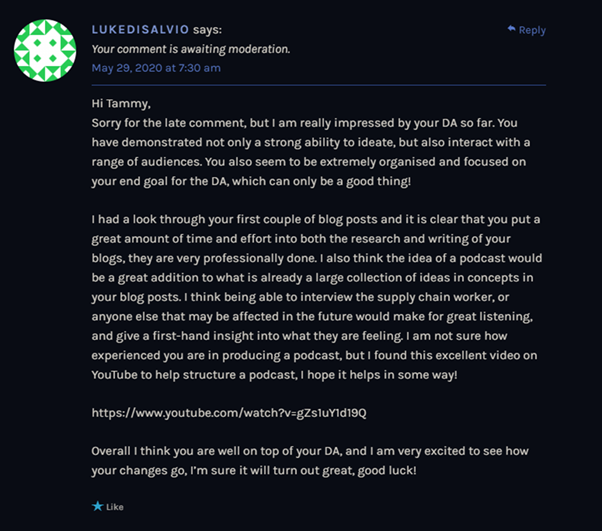
Reflection: I was very impressed with Tammy’s digital artefact so far, particularly her level of research and the time put into each of her blog posts so far. This is something that I think I have found the most difficult about my BCM325 digital artefact, the great deal of time it takes to research and find sources, to create a accurate and credible piece of content. Tammy also wishes to create a podcast to go along with her blog content, and I think that this would be a great way to communicate her findings in a more casual way, potentially speaking to experts or people affected by A.I. and robotics now and in the future.

Madeleine Jones

Description: Madeleine’s digital artefact is looking at the future of virtual shopping, comprised of several blog posts about VR shopping, VR change rooms, and VR grocery stores. Madeleine’s DA focus has shifted since her initial concept of ‘the future of shopping’ to ‘the future of virtual shopping’.

Comment:

Reflection: I found that Madeleine had really narrowed down her focus for her digital artefact, making the topic not too large and easy to base her research around, this is something I have struggled with a little, as I found myself brainstorming all these different topics to speak about and not really knowing which direction to go in. Madeleine was also struggling slightly with her interaction and feedback, so I did some research and found a couple posts on how best to gain some more traction with an audience, many of these topics Madeline is already experimenting with.

BCM325 Beta

I have been struggling, not just with my DA but with online uni as a whole and I go into greater detail in my beta video.


But as it stands I have decided to switch my DA slightly. I still intend to research the future of sports technology, that be it in regards to stadiums, san and player experience, and overall how sport will look in the future.

However, I have decided to switch up my approach to researching and creating content, as well as the platforms I distribute it on. I was initially going to post video essays onto a YouTube channel then promote this through my already established future technology Instagram page from my first year DA. I have now decided, pending feedback, to move my content onto TikTok, this is for several reasons which I talk more about within the beta video, but essentially I found the time constraints of researching and creating longer-form content harder for both myself and my computing hardware to handle.


Of the content I have created so far I saw little interaction, I also was not happy with the final product and the way I went about researching and creating the content.


Hopefully, the revisions I have made to my research, creation, and method will allow me to finish the semester off with a functioning, respectable digital artefact.

Live Tweeting

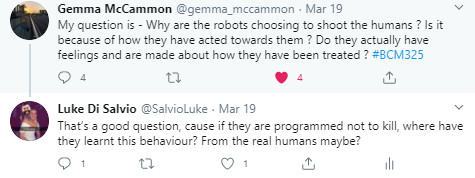
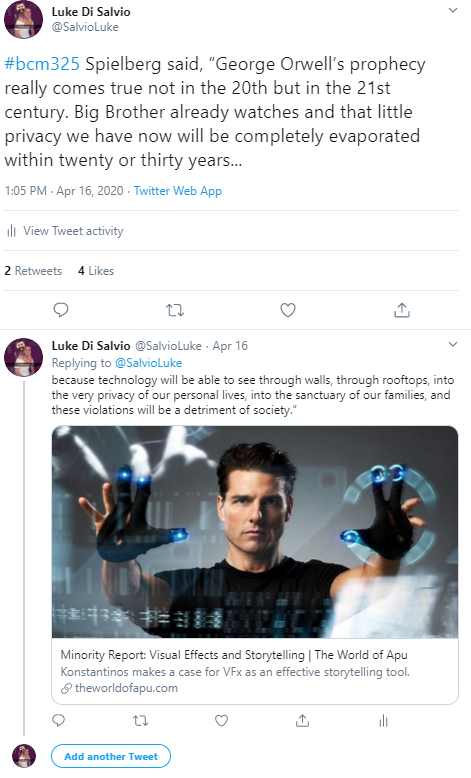
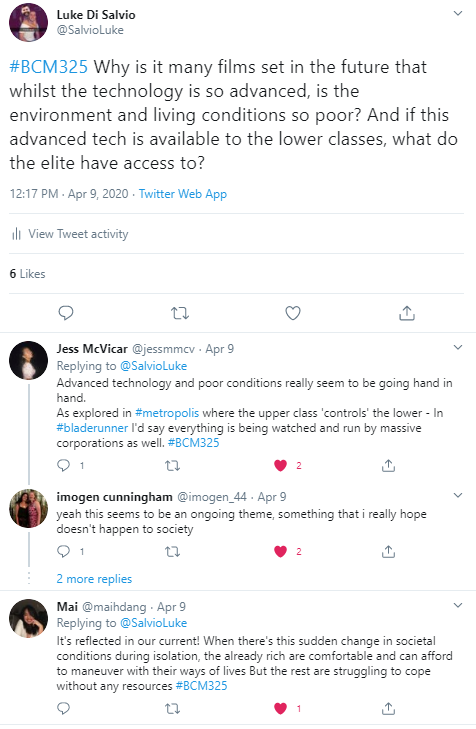
The concept of live tweeting was both new and confusing to me when I first started BCM325, I didn’t see the reason or benefits of doing it. However my mind has been significantly changed since week one, and I now see how beneficial this aspect is to not only further knowledge on the film we are viewing in this week, but also a great way to engage with my peers and gather different opinions on what we are viewing each week. 

Since the start of BCM325 I have learnt how to most effectively live tweet and engage with my peers. I start by looking through the weeks Moodle content, and then the night before researching the film we will be watching the next day, this is not only to gather ideas for tweets, but to also educate myself on what we will be watching and provide an overview of the storyline so that when I am distracted by researching and tweeting during the class I still have somewhat of an idea what is happening in the film.

In our first week we watched ‘Metropolis’ and I think I was a little bit overwhelmed by the concept and didn’t really engage in the research enough or communicate with my peers in a very effective way.

However, moving into week 2 I now understood the concept of live tweeting and began to research, as well as ask questions of my peers and analyse scenes in such a way that allowed for interaction. The images below show how I changed my tweets to include further sources I found, opinions I had, and humour to engage with my peers.

As the semester has continued I have become more comfortable with my tweeting, and think I have developed a good understanding of how to best engage in the class discussion whilst also providing extra resources that may be of interest.

The tweets below have been my two most interacted with tweets (it’s not many compared to others), and I think this was because I had posed a question to my peers in which I found interesting, and this then allows them to respond with their own opinion and research. I enjoy putting these types of tweets out as it allows me to pose a question to the class and gather a range of different ideas and opinions, which intern helps me to learn and engage with the film itself.

Going into the second half of the semester I think I can still improve on some aspects of my live tweeting; one being trying to engage with more of the subject content in my tweets, I have found this a bit difficult so far. Another is keeping the number of tweets I post and my interactions with peers up to the subject standard, as some weeks I get lazy.

Overall, I am enjoying the live tweeting experience in BCM325 and am excited for the rest of the semester as I look to improve my contribution and further my learning. 

Pitch Comments

The second assessment in BCM325 was to evaluate our peers and leave comments on their digital artefact pitch blogs. The task is aimed to share personal thoughts and ideas on our classmate’s work, as well as an opportunity to reflect on our own DA and gain new ideas and methodologies on how to complete them.

The three peers I was assigned were:

  • Ethan Jack Crawshaw, Future Church
  • Imogen Cunningham, Art DA
  • Mai Huong Dang, UOW Creative

Ethan Jack

Description: For this digital artefact, Ethan Jack will be moving church content and services online, partly due to the current COVID-19 crisis, forcing us all to remain home, as well as those who have moved away, or those who are nervous about attending. This content is available both on his Facebook and website.

Comment:

Reflection: After looking through Ethan’s digital artefact I realised how simple yet effective his model was, not only in the current climate, but when things resume to normal as well. I also realised how big of an established audience his DA has the potential to reach, and made me think if my target audience was too small, or whether I should aim my DA at an already established group that are interested in content similar to what I intend to create. This is something I am looking into now.   

Imogen

Description: Imogen’s digital artefact is a continuation from BCM112 and consists of a website and Instagram account to as a way to brand herself as a textile and fibre artist, looking at it as a way to continue into the future as her career progresses.

Comment:

Reflection: Imogen’s digital artefact is good in the sense she is using it as a tool to establish herself in the industry shed like to work in. I gave her some tips of gaining followers and increasing interaction that I found useful during my first year DA’s. I think what I took away from Imogen’s DA is that she is really using this as an opportunity to create something to show to future clients or employers, this is potentially something missing from the current structure of my DA, and something I now think is worth looking into.

Mai

Description: Mai is working as part of the UOW creative for her digital artefact, connecting academics, professionals, and current and future UOW students, creating content on three different platforms, Instagram, Twitter, and TikTok. Mai and the UOW creative team are focusing on four content pillars, course creative output, class environment, creative industries, and campus life.

Comment:

Reflection: Seeing how Mai is reaching a wide audience with her DA by creating content for three different platforms has made me question if posting my content only on YouTube is an effective way to engage an audience. I still have my first year DA (Futretech5000) which is somewhat based around the content I intend to make, and still has a small following, I could possibly use this to engage an audience, and place my content not only on YouTube, but also through my somewhat established Instagram following.

Research Proposal: Living on Campus.

University is a place for students not only to learn, but to also branch out, experience new things, and challenge themselves in ways that a full-time job doesn’t allow. University students travel from far and wide to attend institutions to further their learning, and for some this means moving out of home and living on or close to campus.

In BCM212 we are focusing specifically on the university student experience, gathering information and opinion from a range of sources. We have been tasked to think of a ‘curiosity’ we have regarding the student experience, and research into it.

My curiosity is about campus living,

Specifically, is it worth the financial investment, what the advantages and disadvantages are, and how it impacts study and social life.

I think this is also quite relevant with the current situation university’s around the world face, with the huge reliance of online teaching, begging the question, is traveling or living on campus is even worth it when everything can be achieved online?  As Lodge (2014) explains “Technology has now reached a point where it is conceivable that an education experience on the internet can be comparable to one on a university campus.”

The topic of campus living is of interest to me as I had previously considered living on or close to campus at the beginning of my first year. Living almost an hour away from campus I was weighing up my options, to either stay down in Wollongong during the university week, or to drive back and forth daily and remain living at home.

I chose the latter for a couple of reasons, one was that I was able to condense the days I was required to be on campus due to lectures being recorded and the easy access to material online, meaning I would only need to commute on two days of the week.

The other was the large financial investment that comes along with living on or close to campus, when things such as rent, food, and amenities are considered. This was not a financial situation I was prepared to put myself in at the time.

I posed this financial question to my peers on the BCM212 twitter hashtag, I had limited responses and I put this down to my question potentially being a bit too specific.

However, as you can see the majority agree that the financial commitment is at least worth it in some form or aspect. This research can be taken further with both more open poll questions, as well as written interviews with my BCM212 peers where relevant. I will be able to conduct these through Twitter, Facebook, Google tools, and chats with my lecture class.

This research may also lead me to how different university/college campuses operate around the world, and whether some countries make it more worth while or affordable for students to stay on or close to campus, and what the different pros and cons for students living on campus are.

I have always been curious as to what exactly it is like to move away from home for university, what advantages and disadvantages come with it, how does it affect study and results, does it improve social life, what life skills are learnt during this time, and are students taking full advantage of this time? As Ian F. Wilkinson (2011) from the University of Sydney explains, “Sitting together in a class and working on a group assignment is one thing. Living, drinking, dating and playing sport together is another.”

These are the questions I intend to find out, through both scholarly researches, as well as information gathered from peers and own experiences in regard to university campus living.

Sources:

Polly A. Graham, Sarah Socorro Hurtado & Robert M. Gonyea (2018) The Benefits of Living on Campus: Do Residence Halls Provide Distinctive Environments of Engagement?, Journal of Student Affairs Research and Practice, 55:3, 255-269, DOI: 10.1080/19496591.2018.1474752

Lodge M, J, 2014, ‘The campus is dead: long live the campus?’, The Conversation, Available at: https://theconversation.com/the-campus-is-dead-long-live-the-campus-21372

Wilkinson F, I, 2011, ‘There’s more to university than the qualification at the end’, The Conversation, Available at: https://theconversation.com/theres-more-to-university-than-the-qualification-at-the-end-614

McCuskey, B, 2015, ‘Why there is value in on-campus living’, The Conversation, Available at: https://theconversation.com/why-there-is-value-in-on-campus-living-45691

Graham, P. A.; Hurtado, S. S.; Gonyea, R. M. (2016), Living on campus: Does it still make a difference?, American College Personnel Association Annual Convention, https://scholarworks.iu.edu/dspace/bitstream/handle/2022/24122/Living%20on%20campus-%20Does%20it%20still%20make%20a%20difference.pdf?sequence=1&isAllowed=y

325 Pitch: Sports Future

The BCM325 digital artifact focusses on the future, what life is going to be like in 5, 10, 50, and 100 years. For my personal DA I have chosen to focus on what sport around the world will look like in the next 10 to 20 year, specifically how technology will impact both fans and athletes.

I intend to create three, 5 to 10-minute video essays and upload them on to YouTube, focussing on one, or multiple aspects of the future of sports in each video.

I am not entirely sure as to how long each video will take to both research and produce, but this could be a rough time line:

Weeks 4-6: Research and target audience establishment.

Week 7: First video essay.

Week 8: Beta and audience feedback.

Week 9: Second video essay.

Week 10-11: Research and ideation.

Week 12: Third video essay.

Week 13: Final report.

I am very excited to begin this DA as it is something that has always interested me, even more so at the current time with how sport is being impacted with the current global crisis.

Making

For my digital artefact I wanted to use a range of sources to find content, this included Reddit, YouTube, other Instagram accounts, and news sources from around the world. However, when attempting to post content every day I struggled to find new, relevant information for each post.

My process of making content involved quite abet of research, about 30 minutes each night searching online for relevant news stories or information which fit with the content I wanted to show on the account. However, I often found that some news stories would dominate for a couple of days, making it hard for other more relevant information to come through, and leading to me not finding stories or information with enough substance to make a post about.

When I could not find something to post on a day, I tried to do something with the account, this could be like people who have commented on my posts, follow other technology accounts, or follow other users in the hope that they would follow back. I also did a number of Instagram stories where I asked a question of the audience, this content was a bit more mainstream as I wanted to get as many responses as possible, ultimately I didn’t receive large numbers of replies but it was still engagement.

Overall, I enjoyed making content for this account and I think I learnt more as I went along, however I realised how difficult it can be to find content, as well as make the audience interact with it.

DA Contextual Essay

For my BCM114 digital artefact I decided to make an Instagram page to look at future technologies, and how they will affect the ways in which we live. I would not only showcase small future technologies like phones, but also cars, homes, stadiums, etc. I chose to continue with my BCM112 DA as I enjoyed the research and content creation, I also felt as though I understood Instagram as a platform better and could improve upon my content methods.

When deciding that I was going to continue to do my DA from 112 my focus was to post more regularly, aiming for at least one form of content on the page each day. Once I started to post content on the account I experimented for a couple of weeks with different types of content, being photos, videos, and Instagram stories, as well as sourcing my content from reddit’s such as https://www.reddit.com/r/gadgets/ and https://www.reddit.com/r/Futurology/ , as well as searching through YouTube and Instagram for possible content.

After posting for a couple of weeks I noticed a low number of people hitting the like button on my content with most posts getting fifteen or less likes, compared to BCM112 where my content would get thirty plus likes on almost all my content. When looking through the insights on my posts I found that majority of my new posts had been seen by the same amount of people as my older content, I concluded that the dramatic decrease in likes on my content was due to Instagram removing the number of likes under content during the mid-year holidays, this lead to people no longer seeing a reason to actually like content when they see it, evident below with this semester on the left (post like removal) and last semester on the right (pre like removal).

This image has an empty alt attribute; its file name is image-3.png

As I moved through the semester I wanted to experiment with my account and see what sort of influence an outside source could have on it, so I decided to use the website Fiverr where bought a service from a man located in Israel, in which he described an increase in followers and interaction on a business Instagram account for $20. I was extremely happy with the results and it left my account in a better position with more followers and more activity than it had in the past (before on the left, after on the right).

After this I honestly struggled to maintain the growth, I attempted to ask more questions of the audience but got little response, however the account is in a pretty good spot now, though there is Definity aspects that I could have improved upon to encourage more user interaction. Overall, I am quite happy with how my DA has turned out, I struggled to post everyday due to either a lack of content or my research not being specific enough, however I have enjoyed both learning and researching about futurology and future tech, as well as Instagram as a platform. I learnt firstly how hard it is to grow an audience, and equally how hard it is to maintain their interaction and follows.

Prototyping

I have been experimenting abit with my digital artefact in the past couple of weeks, trying different types of content and hashtags to see what engagement it receives, however the biggest experimentation was through the use of Fiverr services.

Through Fiverr I bought a service from a man located in Israel, in which he described an increase in followers and interaction on a business instagram account. Being unfamiliar with the site and its reliability I chose his cheapest option of $20, from this he requested my account details and took control over the account for six days.

In the following days I received constant notification on my phone of new followers, likes, and comments. As seen below (before on the left, after on the right) the increase in interaction on my account grew throughout the week, and left my account in a better position than what it was.

However what I continue to struggle with this semester is getting users to like my posts, the number of likes my content is receiving is significantly lower than those received on my content posted during the BCM112 course. Ive concluded that the major influencing factor in this is that Instagram had removed the number of likes seen on posts during mid year holidays, I say this because my posts this semester have been seen by the same amount of people, if not more, that those of last semester (last semester on left, this semester on right).

As you can see the number of likes are significantly down on last semester, I am yet to find a method that increases reach to like ration, this will be looked at further before the end of this semester.

Overall I am relatively happy with what I have produced so far, I think I am learning alot through studying the insights and numbers on my posts, aswell as the experimentation with Fiverr has opened up a new service that can help with my DA moving into the future, it is a slow build but I feel it is going in the right direction.

Beta

For a brief overview of what I am doing with my digital artifact, I decided to make an instagram page to look at future technologies, and how they will affect the ways in which we live. I would not only showcase small future technologies like phones, but also cars, homes, stadiums, etc. I decided to use instagram to share the content, and look at reddit pages, other instagram accounts, and news articles to find relevant content to share on my page.

I am pretty happy with the progress so far, however I have run into some issues along the way, one being that since instagram removed the number of like from posts I have notived a significant drop off in likes, however the same amount of people are seeing the content on their feed, if not more than last semester. However I am happier with the types of content I am posting, as it has covered a greater range of topics, whilst still focusing on the future living aspect.

I also used a service on Fiverr, which was to help grow my follower numbers and user interaction, and I am very happy with the results. I gained almost 50 followers in the week my account was taken over, and the interaction on my posts also increased. I think this was a good tool to play around with, as there was a range of services that could be more of an assistance for the future of my DA.

Overall I am happy with the progress of my DA, however I need to continue to experiment with different form of content, aswell as different hashtag groups to encourage user interaction.

Website Built with WordPress.com.

Up ↑

Design a site like this with WordPress.com
Get started