In week three of BCM206 we learnt about the three networking types, being centralised, decentralised, and distributed, with all used as an away to connect people with information. A centralised network is the most used, this network comes from a single point, which means what information is distributed can be controlled with little ability to respond, and example is most mainstream media. Decentralised and distributed however allow members outside of a centralised system to interact and be an active part of the network, communicating with the network and other members, showing emotion through things like posts, comments, and likes.
As well as this the subject of emotional weaponization was explored, where programs attempt to get an emotional response out of a viewer by presenting content which can help sway peoples opinions, almost attempting to make the viewer think a certain way or ignore a particular subject. This method is most prominent in centralised networks.
For my media niche I am going to be exploring the YouTube group NELK and try to understand how they have created such a large and loyal fanbase to fund their channel.
Problematising
If I were to problematise the niche so others could better understand the niche I would answer questions such as, who is NELK? What content do they create? Why do they receive little to no money from YouTube advertisements? How do they make their money?
If I was to answer this very quickly without thorough background research, NELK is a vlog/prank channel who due to the content they create which involves pranks, alcohol, and drugs, YouTube has cut almost all funding to the channel, so to support the channel their loyal fans fund them through buying clothing and merchandise. All these questions and answers will be refined with facts and specific examples once I begin to properly investigate.
This research topic is of great interest of me as I wish to explore how NELK have survived on YouTube without being paid by the platform themselves, this sort of research can may also be useful in regards to future employment opportunities, whether it’s helping to create large and loyal fan or consumer bases for a company, or sports team, or even influencer, the ability to be almost fully funded by those who watch or interact with your brand is a skill NELK has harnessed and I wish to learn more about.
Research Plan
Documenting my research may take some effort as I plan to look through a lot of NELK’s content on all their social sites, YouTube of course, but also their Instagram, TikTok, and personal site. For data collection I plan to,
View YouTube content, taking notes on my laptop and utilising screenshots to document interesting aspects I may find.
View social accounts and again take notes, as well as looking through likes and comments to grab fan perspective.
I will also follow all of their content throughout the weeks and note down when they are trying to sell the viewers something, this may be hard and I may need to look at their content in a different way than normal as there may be hidden marketing techniques they use that aren’t obvious upon first viewing.
I will also attempt to find fan videos or blogs which help explain how fans outside of myself think about NELK and supporting them financially.
Research Schedule
For the schedule of this research it is a little hard to put time frames on things, there is obviously a plethora of past content for me to go through and document findings, but for new content I have to wait for those at NELK to create and upload it. This is also slightly inconvenient as the group has only recently launched their paid subscription site ‘Send Club’ in the last two weeks, this is a very interesting aspect to look at, however it is only very early on and thus not a whole lot of data to gather.
This schedule is obviously very rough and can be changed very easily. Hopefully by setting things out through weeks I can give myself enough time to commit to the research required whilst also completing other subject content
For my digital artefact in BCM206 I want to go through the start to finish process of creating an online drop shipping store and marketing it through Facebook and Instagram. What is dropshipping?
Dropshipping is a supply chain management method in which the retailer does not keep goods in stock but instead transfers its customer’s orders and shipment details to the manufacturer, who then ships the goods directly to the customer.
This concept for a DA really interests me as I want to experiment with gaining an audience through buyers, I want to create an online store, Facebook, and Instagram page for the product I chose, then use these platforms to interact with consumers and market to them, with the goal being to sell the product.
The aim of this DA is not to make money, rather learn how to engage with an audience and make them consumers of a product through advertisements, interaction, and product content.
The world as we know it today is vastly different to that of even one hundred years ago, obviously. But I think one of the biggest and most significant changes has been how we communicate with each other. In todays world we are blessed with the ability to instantaneously speak to people on the other side of the world, a far dream from those who sent messages via horseback, train, or boat.
The real significant step came with the invention of the telegraph, allowing for communicate at a rate far greater than what was the normal. Transmitting Morse code signals through wires to create a message was the first step to lead us to what we now have with the internet.
The control has been given to the individual, known as a distributed network, where in the 1840’s a centralised network was used. The internet has given the power to the people.
After having a solid week to consider the media niche I really wanted to focus on as well as speaking with my tutor, I have decided to focus my research on the popular YouTube group ‘NELK’ and take a deeper dive into what makes them successful as essentially a social media ‘brand’, how they have created a large and supportive fanbase, and how exactly they have used their fans and their media channels to create large amounts of revenue.
What interests me the most about the group is how they have developed over time and used other media platforms apart from YouTube to create an excellent connection with their fanbase. This also ties into how the group make the majority if their money, because of the nature of the content they upload onto YouTube they receive little to no money from advertisements per video, so the group has had to find other methods to generate revenue, and the first step to this is to create a large fandom to help financially back them.
As you can see below in the network map the YouTube group is has several platforms to interact with their fanbase, as well as several platforms to create an income through. I intend to take a deeper look into what platform they make the most money from, and how they promote through each of their different channels. This network map is very basic as it is far too large to look at each member of the group and their networking’s at this stage, as I go through my research I will mention notable aspects of individual members network maps if it comes relevant to the group as a whole. It will also be very interesting to focus on the ‘Send Club’ the groups monthly subscription site where fans can see exclusive footage, win prizes, etc. This aspect is brand new only launching on 11th of August 2020 with mixed reactions from fans.
I ultimately decided to pursue this niche for my research task as I think their business model and ability to create fan loyalty is relevant to many future careers I may take part in, as well as just personal interest as to how they operate and have created a large, loyal, and financially supportive fan base.
I am coming to this research niche as a fan of NELK, but only in recent times have I come connected again with the YouTube group. I can remember watching some of their old videos a few years ago but never really followed their journey. Fast forward to this year when a friend encouraged me to watch their latest video and I was blown away not only with the content produced, but how they were using their platforms to interact with their fan base and create a financial gain.
From my research there seems to be no relevant scholarly research done on the group themselves, and this is understandable as the group has only blown up with popularity in the last couple of years. This means I will need to find other sources to validate my research, this should be easily done as many of the members have spoken publicly about the ‘brands’ success and how they engage with their fans to gain a financial backing.
I am really excited to dive deep into this project as it is an area I have been curious about since I rediscovered the group, and I think it can lead me to understand some current and effective methods of interaction and marketing that can help in my future endeavours.
I am currently split on what to focus on as my media niche moving forward with BCM241 as I have three ideas which all hold merit in their own regard. My current ideas focus on an ethnographic investigation into one of these options:
Rugby League media, how reputable is it, how much engagement do fans receive, etc.
YouTube group ‘NELK’ and their rise to fame, how they promote their brand and merchandise, and how they have created such a loyal following.
A focus on the duo of ‘Hamish and Andy’ and the content they create, how they have been able to adapt over time, how they keep great interaction from fans over several applications, etc.
My issue is that I can find positives in each option, with ‘A’ being the area most familiar and a focus on an area of media I may wish to pursue one day, ‘B’ being the most intriguing and exciting option to research, and ‘C’ being the best fit for what examples given by the Moodle site and lectures thus far.
Ideally I would like to pursue either option ‘A’ or ‘B’ as these are the two areas I think would both be focused around a future career as well as being the most interesting to research, however I am not sure if these are too broad and not suitable as a niche. I intend to ask my peers and tutor about which is most suitable for me, nether the less here is a short snapshot of each possible niche.
Rugby League Media
This option is probably the broadest but also the one most likely to have similarities with possible career choices down the line. For this option I would probably choose one of the shows or one of the channels that cover Rugby League and take a deeper dive into what impact and presence it has on the fans, as well as what interaction through other mediums the fans have, and whether it is a positive for the sport. I think this topic would be a good option, I am just unsure on what specific aspect to focus on and how to best communicate it.
NELK
The YouTube channel was originally created in 2010 by Kyle Forgeard, the channel creates videos around pranks, skits, and vlogs with some videos encompassing all three aspects. The channel has many members both on and behind camera, and currently sits at 5.2 million subscribers, as well as a large presence on social media platforms and their own website separate from the YouTube channel. What makes NELK so interesting is that due to the nature of their content, the group receives very little to no money from their video uploads as YouTube demonetises and age-restricts their content. This means the group has had to find alternate ways to make money, and this is where their ability to create a large and loyal fanbase has meant that when they release a product such as clothing and merchandise they receive large a financial backing by their fans. This concept is interesting to me and how their content has connected themselves with the fans to such a successful point.
Hamish and Andy
The pair originally met at the University of Melbourne and began their radio careers in 2003, with variations of their show airing over a fifteen year period, and across a number of radio stations. The pair were not limited to radio however, with seventeen television series and specials across four TV networks. Currently the pair host their own podcast show simply named ‘Hamish and Andy’ as well as posting current and past content on their social media sites with a collective of 5.2 million followers across their YouTube, twitter, Instagram, and Facebook sites. As I have grown up I have found it quite amazing how both Hamish and Andy have been able to create enjoyable visual and audio content for the target audience, as well as how their content is so easily consumed by audiences of different ages.
My original concept for my BCM325 digital artefact was to look specifically how technology was going to impact athletes and sporting fans 5, 10, 25, and 50 years into the future. My intentions were to create a dedicated YouTube channel and upload three videos, each around 5-10 minutes in length focussing on one aspect of future technology in sports, whether that be in regard to fans, athletes, or another aspect. I also planned to use a previous digital artefact to help promote traffic to the YouTube channel.
Methodology:
My digital artefact was ideated a lot since the initial pitch, through feedback from my tutor and peers, as well as out of necessity. The initial stages of my DA were slow, and I struggled to maintain the timeline outlined in my pitch.
I created the initial YouTube channel ‘Sports Future’ and began to research into the topic of future stadium technology. Through feedback I made intended to make shorter videos around 3 minutes.
I created the initial video and shared it on my previous DA ‘FutureTech5000’ Instagram page. But I was struggling a lot with old hardware and premiere pro at the time, as well as how long it took to research thoroughly and edit the content.
After my beta I decided to shift platform onto TikTok, this allowed for easier video editing, as well as making it less time consuming.
I began to create my own content whilst also sharing some from other creators, this was to provide a continuous stream of content on the TikTok page ‘Sports Tech 5000’.
I began to create shorter, informative TikToks in which I would use visuals and research found on the internet, with a narration from myself.
Background research:
Prior to starting my DA I found a couple of YouTube channels doing similar content, but were focused very much on today’s technology rather than the future. When moving over to TikTok I could not find any accounts using search terms which were creating similar content regarding future technology and its impact on sport.
Utility:
The target audience for my DA were both sports and tech fans who were intrigued to see what technologies were currently being developed and what impact they could potentially have moving into the future.
The original YouTube channel gained little interaction, however the TikTok account gained a little bit of traction with the target audience, with the account gaining 5 followers, over 150 likes, and roughly 1 500 views with all content combined.
Success and limitations:
Limitations: The original DA concept created a real strain on both my hardware and available time to research and create content, this led to me struggling to find motivation. However once upgrading my hardware and moving platforms to TikTok I found a new motivation and enjoyment in researching and creating content, as neither took up as much time as a YouTube essay style video would.
Success: With the feedback from my tutor and peers I found great success on the new platform of TikTok, with far greater interaction with an audience and gaining a small following. I found that TikTok is a far easier platform to reach audiences than YouTube, especially with the use of hashtags and popular songs.
Future:
This DA has been both extremely difficult and satisfying to complete, it has taken ideation and review to get to the final product. Fully embracing the future cultures aspect took some time and research to find a formula that worked for me while also addressing the DA focus. I really enjoyed changing and learning during this DA and have gained valuable knowledge and skills out of this semester.
Are the financial costs that come with moving out of home and living on or close to university campus worth it when considering study, social, and personal aspect? This is obviously personal to each students situation and what they are looking for out of their university experience, whilst UOW cant control students experience living off campus, they do control the on campus experience, are they providing the students the opportunities and experiences they deserve for their large financial investment?
The research findings show that many students who have moved out of home do find the study, social, and personal opportunities and experiences worth the investment, however for many students this is their only option, living to far away from campus to commute each day.
What surprised me about the survey findings was that there was not a single participant who had lived on or close to campus whose regular home was less than an hour’s travel time, obviously the sample size was small, but I expected a few people to have their regular home within Wollongong yet still choose to live on campus as a new experience and seeking independence. This was preconceived idea of mine potentially influenced by films, where students just move out of home to begin a life of study and partying.
In terms of my research topic and survey, I think it would have been beneficial to potentially have an interview with someone who has actually moved out of home to question their reasoning, what it was like, what they wished they knew before, and how they manage their studies, with work, and paying for the cost of living. Whilst the participants I had were very open and gave very in-depth answers, I think an interview may have made up for the smaller sample size of respondents.
Additionally, I could have possibly researched into other university accommodation within Australia, comparing prices and how worth while they were. Moreover I could have done some further research into American colleges and how much they cost and how they operate with their students in accommodation, as I had previously heard that the American on campus experience is far greater than the one we experience in Australia.
Personally I found this assignment to be extremely beneficial and enlightening, not only with the information received from my peers in regards to their experience, but learning to engage in my research and really utilise the remote learning style we have faced this semester.
The university experience is often something completely new for students, especially directly out of high school, the attendance is not always compulsory, the campus is a huge maze, and you can drink alcohol between classes, a university is a place for students not only to learn, but to also branch out, experience new things, and challenge themselves in ways they had never considered.
This research project was conducted within the BCM212 class, a Bachelor of Communications and Media core subject taught at the University of Wollongong. Through the use of twitter polls (20 responses) and internet research, I wanted to gather thoughts and opinions from students who both still live at home (like myself) and those who have moved out to live on or closer to the UOW campus.
My first thoughts and opinions when considering this research topic were this, for those students who live multiple hours away from the university campus the logical and practical solution is to move to accommodation closer to UOW, unless however the degree could be completed in an online format. Additionally, I thought that if students lived not too far from campus (around 1-hour travel time) and decided to move out of home, the financial cost starting at $195 per week for UOW accommodation, majorly outweighed the benefits regarding study, social, and personal life.
The topic has also become more prevalent since the semester began, with all students conducting their learning remotely, hence no longer needing to attend class on campus. This has also raised the question on the necessity to learn on campus, and why students who live far distances away cant do their entire course online, as Lodge (2014) explains “Technology has now reached a point where it is conceivable that an education experience on the internet can be comparable to one on a university campus”.
Within my research survey, I had two sections, the first was for all students to fill out, the second was some additional questions for those who have at some point in their university life moved out to live on or close to campus. The questions were designed to give an opinion on what individuals had experienced through their university journey.
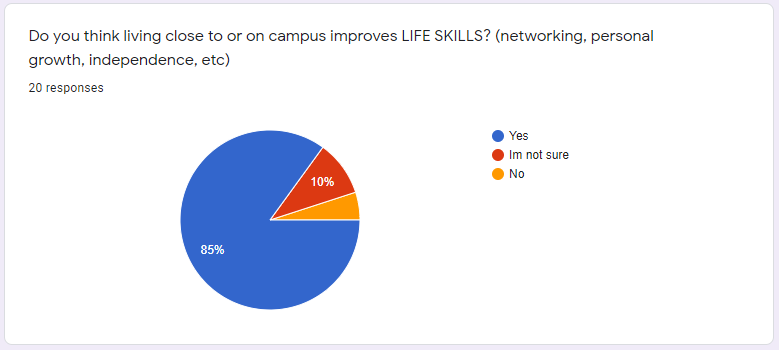
The first couple of discussion questions established that many of the participants live less than one hour away from the Wollongong campus, with some international student outliers. What was also evident is that while 75% of participants had seriously considered moving out of home for university, only 45% followed through, this says many students are intrigued about the opportunity to move out for university but come across issues that may deter them from doing so. Additionally, both sets of respondents acknowledged many potential benefits that come with living closer to campus, not considering any external factors. Majority of participants also commented that if the cost of living on or close to campus was lower, themselves and other students would be more inclined to move out, “One of the biggest (if not the greatest) drawbacks and concerns students have is rent” stated one participant.
When watching American teen movies the prospect of going to college, living in dorms, and having huge parties seems like an absolute dream for a young adult, when speaking to a family friend who went over on a basketball scholarship he said it was close to the movies. Yet back home in Australia many students do not talk as highly of student accommodation, “Australia has many world-class universities, but some are failing their students by not providing the on-campus, life changing experiences available elsewhere.” (F.Wilkinson, 2011). Almost all participants surveyed said they would be more inclined to move out of home and live on or close to campus if the experience resembled that of a college campus in America, with greater opportunities personally, socially, and physically in regards to sports. Two researchers out of the University of Iowa and Pennsylvania State University also found that on-campus students in America were more likely to stay in school and to graduate than their commuter counterparts, as well as first-year students living on campus reported higher-quality interactions with other students when compared with off-campus students (McCuskey, 2015). A couple of respondents commented on how very different the experience is regarding UOW accommodation, highlighting how ‘restricting’ the university has set up the whole program, leading one respondent to say their time living on campus was “unenjoyable”.
Taking the research survey further with students who have in the past or are currently living out of home for university reasons shed a great deal of light on the subject matter from those who have the true experience to put behind their thoughts and opinions. Firstly, all respondents (10) to this section of the survey identified distance from Wollongong campus as being the major factor in their decision to move out of the home. Additionally, with the move to remote learning for all students, 80% of participants said they would or at least consider doing some of their degrees from home, this number may be different in a time without Covid-19 lockdown restrictions as these have eliminated many of the social aspects students enjoy through on-campus living.
When asking participants about how worth the financial investment has been concerning study, social aspects, and lifestyle, the consensus was that these aspects were generally worth the investment in at least some capacity, in particular, the social and lifestyle aspects, many participants commenting on the sense of independence and the newfound friends met through living out of the home.
Through researching this topic it has become evident that whilst moving out of home and living on or close to UOW campus brings a large financial commitment, many aspects make it worth the investment particularly for those who live a large distance from campus, and participants acknowledge the positive impacts in study, social, and personal life that come with becoming independent. Presumably many students would like to experience this independence during their university years, however for many, it is far cheaper to commute and remain living at home, “This is the same at most universities in Australia because they are in big cities, have limited on-campus accommodation, and the costs of living force you to stay at home.” (F.Wilkinson, 2011).
Refrences:
Lodge M, J, 2014, ‘The campus is dead: long live the campus?’, The Conversation, Available at:
Live-tweeting was a completely new concept to me when I first started BCM325, I found it a little bit strange and did not see what the actual benefit was. Fast forward to the end of the semester and live-tweeting is now one of my favourite aspects of BCM325, not only has it helped develop my research skills and multitasking, but also introduced me to films I had never seen or heard of.
My process for finding information about the different films we viewed each week was simple yet very effective. I would first find a trailer for the film and view it, bringing myself up to speed with the basic plot of the film, after this, I would surf the web with specific interests in mind, such as movie themes, facts, visual effects, predictions, and a few others depending on the film. Through browsing online sources, I not only gained a better overall understanding of the film but also allowed me to start drafting some tweets to post during the screening.
As the semester continued, I developed my skills to use the screening time as an opportunity to learn new things both online and through my peers. This was carried across into my live tweets, as I found that the greater depth of knowledge or question in a tweet, the more likely it is for others to interact with it.
I found throughout the whole semester that my peers in the BCM325 class were most likely to interact with tweets, as this provided them with a place to give an answer and hence have more material to put into this tweeting assessment.
I also very much utilised this method, seeking out tweets with prominent questions, and answering with gathered knowledge or my opinion. I found this to be one of the most effective ways to learn during the live screenings, as not only were you forced as an individual to ponder the question being asked, but other were doing the same, sharing their own opinions and knowledge to create an informative discussion on a topic related to the weeks screening, this was my favourite part of the live tweeting experience.
Overall, I have really enjoyed the live tweeting experience in BCM325, it was something completely new to me, as were many of the films showed. Critiquing myself, I think I did a pretty good job at finding relevant and informative information for my tweets, as well as posting educated questions to my peers, and interacting with them in an informed and effective way. I did find it hard to put some of the lecture content into tweets and this is something I tried to improve throughout.
This has been one of my favourite activities within a university subject, whilst also teaching me new skills and communication methods in a light-hearted and enjoyable way.




 disalvio.home.blog